
Anyone considering filler injections may have heard the term... Blunt needle filler with sharp needle Then you might wonder what the difference is, and which one is less painful, causes less swelling, or is safer. In reality, the device used for injection significantly affects the sensation during the procedure, the post-injection results, and the chance of bruising. Many people choose incorrectly because they don't understand the advantages and limitations of each type. Some cases are better suited to a blunt needle, while other areas require a sharp needle for optimal results. This article will explain this in simple terms. What's the difference between using a blunt needle and a sharp needle for filler injections? Which type is painless and doesn't cause swelling, and which one should I choose to suit my needs? Before deciding to actually get the injection.
Main content
- Sharp Needle These needles are designed to precisely cut through skin tissue and are easy to use. The needle tips are sharpened and beveled to reduce resistance when inserting them into the skin.
- Blunt needle (Cannula / Blunt Needle) This needle has a rounded, non-sharp tip. As it moves through tissue, it deflects blood vessels and nerves, rather than cutting or piercing them like a sharp needle.
- blunt needleTherefore, it is suitable for injecting fillers into delicate and large areas, while also reducing the chance of bruising.Sharp needleIdeal for spot touch-ups and requiring precision.
- Blunt needle filler injection technique This method prioritizes safety and reduces the risk of injecting into blood vessels and nerves, which could cause serious side effects. It also minimizes bruising and allows for coverage of a wide area with only a single incision.
Sharp Needle
Sharp needles are designed to precisely cut through skin tissue and are easy to use. The needle tip is ground to a sharp, beveled shape to reduce resistance during penetration. The size of the hole in the center of the needle varies depending on the needle gauge; the higher the gauge number, the smaller the needle diameter.
Advantages of needle-assisted fillers.
- It offers high precision and can inject into all layers of the skin. Furthermore, if a change in injection site is needed, the needle can be withdrawn and reinserted immediately without the need for a pre-incision. The sharp needle tip is suitable for viscous substances such as Botox or various vitamins, resulting in less pain for the patient. It is also ideal for injections in areas requiring high precision, such as the lips, nose, or nasolabial folds.
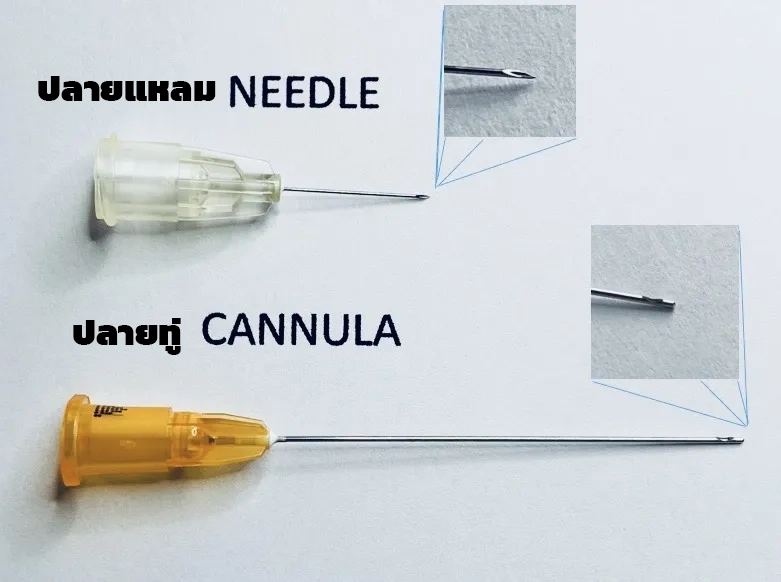
Blunt needle (Cannula / Blunt Needle)
A blunt-tipped cannula (or blunt needle) has a curved, non-sharp tip. This means that when the needle moves through tissue, it deflects blood vessels and nerves instead of cutting or piercing them like a sharp needle. Additionally, the drug delivery channel is positioned to the side, allowing for even drug distribution and better control of drug direction. Cannula needles are also typically longer than regular needles (approximately 25-70 mm) and highly flexible, able to bend to conform to the facial structure.
Advantages of blunt needle fillers.
- It reduces the chance of the needle piercing a blood vessel, which could cause tissue necrosis or blindness. It also reduces bruising because it doesn't cut through as many capillaries as a sharp needle, and allows for injection over a wider area. Therefore, blunt-tipped needles are suitable for injecting fillers into large areas such as the cheeks, temples, or under the eyes.
Blunt needle filler vs. sharp needle filler
| section | Sharp Needle | Blunt needle (Cannula / Blunt Needle) |
| Needle characteristics | The needle tips are ground to a sharp, beveled shape to reduce resistance when piercing the skin. The size of the hole in the center of the needle varies depending on the needle gauge. | The needle has a rounded, non-sharp tip, and the injection site is located on the side to allow the medication to distribute evenly and be easily controlled. |
| Suitable position | Lips, nose, or nasolabial folds. | Cheeks, temples, or under the eyes |
| Pain level | It will feel less painful during the initial stabbing, but the pain will build up if multiple stabbings are performed. | It will be painful when the skin is first incised, but during the injection, you'll feel more of a tightness than pain. |
| Level of trauma | There is a higher chance of bruising because the needle is sharp and may cut small blood vessels. | The chance of bruising is very low because the needle tip is rounded, causing the blood vessels and nerves to be displaced. |
| accuracy | High accuracy | Medium accuracy |
| safety | There is a high risk because the needle tip is sharp and can easily penetrate a blood vessel. | It is very safe. |
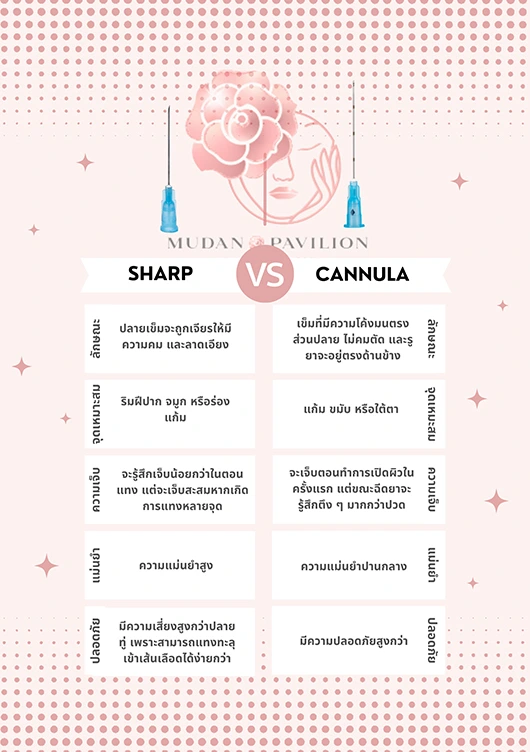
Therefore, blunt-tipped needles are suitable for injecting fillers in delicate and large areas, as well as reducing the chance of bruising, while sharp-tipped needles are suitable for targeted injections and requiring precision.
Blunt needle filler injection technique
The blunt needle filler injection technique prioritizes safety and reduces the risk of injecting blood vessels and nerves, which could lead to serious side effects. It also minimizes bruising and swelling and allows for coverage of a wide area with only a single incision.
- The size of the blunt needle must be chosen to match the viscosity of the filler and the injection site; for example, 22G – 23G is suitable for...Fillers with a firm texture Alternatively, for deep layer injections, or 27G, it is suitable for fillers with a fine texture in the superficial layer.
- For blunt-needle filler injections, the doctor will first inject a local anesthetic into the area. This anesthetic, which is in liquid form, will be left in place for 3-5 minutes and will help lubricate the blood vessels, reducing the chance of the blunt needle entering a blood vessel.
- A blunt needle has no sharp tip for piercing the skin; therefore, a sharp needle is used to create a small hole, and then the blunt needle is inserted.
- Before injecting any filler, the doctor will perform a test by drawing the needle in to ensure that no blood vessel is hit. The needle will be held in place for at least 10 seconds. If the needle cuts a blood vessel, blood will be mixed with the filler. If no blood vessel is hit, the doctor will begin injecting the filler.
- During filler injection, the doctor will palpate the tip of the needle to check that the filler is exiting the tip, similar to inflating a balloon. This ensures that the filler is not entering a blood vessel.
- During the procedure, the doctor must closely observe the patient's skin color. If the filler enters a blood vessel, the skin will become paler or redden over a wide area. This is to allow for timely intervention in case of an emergency.
- When using a blunt needle for filler injections, the doctor will administer the filler slowly to minimize pressure, keeping it at no more than 0.1 CC per injection point. This allows for timely intervention in case of emergencies.