

Many people want to try fillers, but they have many questions in mind: Is it painful? How long does it last? Can it be corrected if I don't like the results? Is it dangerous to get frequent injections? Because it's a matter of appearance that will stay with you for a long time, everyone wants to do their research before making a decision. Today, we've compiled the most frequently asked questions about fillers and answered them all, so you can clear up any doubts.

What is filler?
Fillers are synthetic substances that are biodegradable, stable, and have minimal side effects. The most commonly used substance today is hyaluronic acid, which is manufactured to mimic the body's natural substances. It is used to replace key components of the skin's structure, such as collagen and elastin, which decrease with age.
What is filler injection?
Filler injections are a cosmetic procedure to treat wrinkles, deep lines, and correct facial structure by injecting hyaluronic acid fillers into skin layers that have begun to deteriorate and collapse with age.
What are the benefits of fillers?
Fillers help to fill in gaps under the skin where it has collapsed, resulting in smoother, firmer skin. They can fill in acne scars, improve skin texture, and address deep wrinkles, nasolabial folds, and chin lines. Additionally, they help to hydrate the skin, giving it a plump appearance, and contribute to a more natural-looking facial contour.
Is getting filler injections dangerous? And is it painful?
Filler injections are painless and safe when performed by a skilled physician using authentic fillers approved by the Food and Drug Administration (FDA). These types of fillers can naturally break down, or can be dissolved if the results are unsatisfactory.
What are the common side effects after filler injections?
After filler injection, there may be some swelling and redness from the needle, but the swelling will subside within 14 days, and the redness will fade within 2-3 days.
How long do the results of fillers last?
Typically, results last approximately 6–24 months, but the duration can vary depending on the amount used and the manufacturing technology, which affects the properties, firmness, elasticity, distribution, and size of the filler, etc. For these reasons, the duration of results differs between brands and models of fillers.
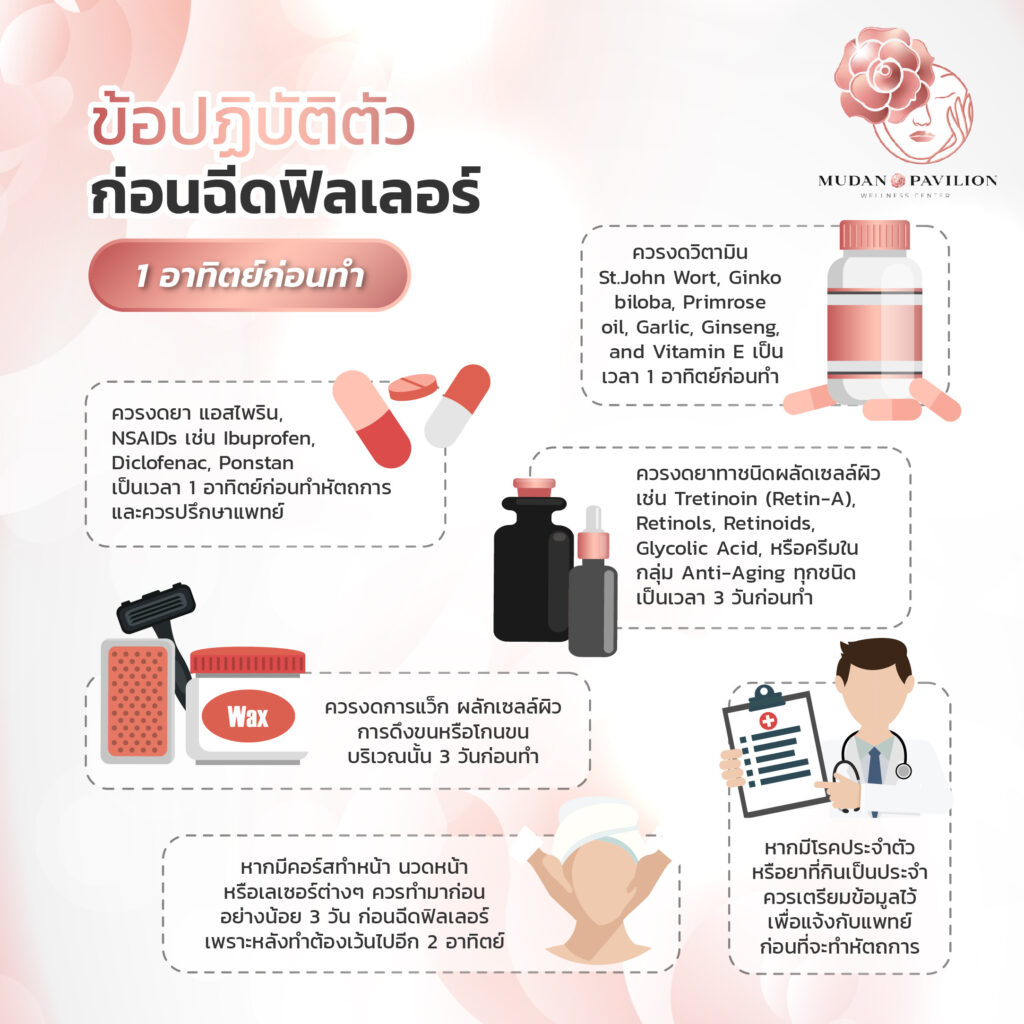
How should I prepare before getting filler injections?
- Avoid taking non-steroidal anti-inflammatory drugs (NSAIDs) such as aspirin, ibuprofen, diclofenac, and naproxen for at least 7 days before the injection to prevent slow blood clotting.
- Avoid taking supplements such as fish oil, vitamin E, ginkgo biloba extract, ginseng, garlic tablets, and herbs that stimulate blood circulation for at least 7 days before the injection.
- Avoid applying exfoliating products such as Retinoids, AHA, BHA, and Glycolic Acid for at least 5 days before the injection to prevent inflammation and skin sensitivity.
- Avoid pulling, shaving, waxing, laser treatment, massaging, or using hair removal creams in the injection area for at least 5 days prior to the injection to prevent infection.
- Avoid consuming alcoholic beverages for at least 2 days before the injection, as it causes blood vessels to dilate, resulting in stronger blood flow, leading to easier bruising and prolonged swelling.
- Refrain from smoking for one day before the injection, as nicotine can impair blood circulation and affect wound healing.
- Avoid activities that increase your internal body temperature, such as intense cardio, sauna, or hot baths, for one day.
- If you have any underlying medical conditions, a history of drug allergies, or are taking any medications regularly, please inform your doctor before the injection.
- If the injection site becomes inflamed or infected, the injection should be postponed until the skin has recovered.

How should I take care of myself after getting filler injections?
- Avoid touching the injection site for 14 days after the injection, as this may cause the filler to shift out of position.
- Avoid exposure to heat or activities that cause facial redness for at least one month to prevent inflammation and filler migration to other areas.
- Avoid applying any medications or vitamins that increase bleeding, such as aspirin, vitamin E, and ginkgo biloba, for 7 days.
- Refrain from consuming alcohol and smoking for 14 days.
- Avoid wearing makeup for at least one day, as cosmetics can cause inflammation.
- Drink plenty of water, at least 8-10 glasses a day, because fillers absorb water, making them look fuller and helping the results last longer.
- Applying a cold compress, along with drinking gotu kola juice or pumpkin juice, can help reduce swelling more quickly.
- Take your medication as prescribed by your doctor to reduce the chance of experiencing side effects.
- Observe your symptoms after the injection, such as skin color, pain, or swelling. If you experience any abnormalities, see a doctor immediately.
If I don't like the result, can I edit or remove it?
Don't worry about this, because in many cases, patients who receive filler injections may sometimes experience undesirable problems such as filler lumps, swelling, unnatural appearance, or the need to reshape their face. These cases can all be corrected with... "Injection to dissolve filler" (Further reading is possible.) And of course, filler dissolving injections are a safe and harmless cosmetic procedure, but they must be performed by a skilled and experienced physician.
Can fillers be injected frequently?
Re-injecting fillers or getting them frequently is definitely possible because most fillers are substances that break down naturally and are not permanent. Therefore, you can repeat the injection to maintain your desired results. HA (Hyaluronic Acid) fillers, the most commonly used type, typically last about 4–12 months. Therefore, touch-ups are usually considered when the results begin to fade. However, minor touch-ups can be done as early as 2–4 weeks after the initial injection, once the swelling has subsided and the results are clearly assessed. Nevertheless, you should avoid frequent injections without prior assessment of your existing filler, as this may lead to over-injection, resulting in lumps or uneven skin texture. Always consult a specialist before making any decisions.
Is it okay to wear makeup before getting filler injections?
You can apply makeup before filler injection because the staff will cleanse your face with a gentle cleansing formula beforehand.
Can I get filler injections if I have acne?
Doctors usually consider the type of acne and the injection site. For example, minor comedones can be treated, but for inflamed acne, cystic acne, or skin infection, the doctor will recommend postponing the injection because it may cause inflammation or the infection to spread and become pus-filled.

What should you avoid eating after getting filler injections?
Actually, the restrictions on eating food or snacks after filler injections aren't very strict. The main points are...Avoid very hot or very cold food and drinks. Avoid alcoholic beverages IncludingAvoid foods that may cause allergic reactions. For example, seafood, as it may cause an allergic reaction in the area where the filler was injected. However, you can find more details at... [Guidelines] What not to eat before and after filler injection.
Which clinic is best for getting filler injections?
A standard clinic or medical facility must have a medical facility operating license and an 11-digit operating permit issued by the Ministry of Public Health, or display a sign with the name of the medical facility, license number, and the name and photograph of the attending physician outside the examination room. This also includes having credible reviews. However, you can click to see the details. How to choose the best place to get filler injections. Please check the attached link for the necessary information.