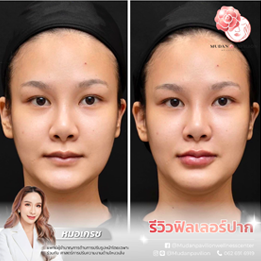

Many people may never have noticed before that... Uneven forehead One day, you might look in the mirror or see a picture of yourself and think, "Hey, why does my forehead look asymmetrical? One side is more prominent than the other." In reality, this problem is more common than you think and can be caused by many factors, including bone structure, uneven muscle use, or even unconscious daily habits. The question then becomes, "Can this be fixed, and if so, what should I do?"
Main Idea
- An uneven forehead; the two sides of the forehead have different thicknesses; the forehead is not a smooth, sloping flat surface but has a rough, wavy texture; there are raised bumps or indentations; the brow ridges are not of the same height; and the upper and lower parts of the forehead do not match.
- An uneven or prominent forehead can be caused by several factors, including genetics, age, bone spurs, high brow ridges, uneven subcutaneous fat atrophy, muscle function, accidents, side effects from cosmetic procedures, bone growth disorders, and sleeping habits.
- An uneven or convex forehead can be corrected with filler injections, fat grafting, or forehead augmentation surgery.
The forehead is uneven and protruding.
An uneven forehead is a condition where the thickness of the skin, tissue, or bone in the forehead area is not the same on both sides. For example, the right side may be more prominent and aesthetically pleasing, while the left side is flat or sunken, making the face look asymmetrical when viewed from the side. Additionally, the forehead may not be a smooth, sloping flat surface, but rather rough or wavy, with localized bumps or depressions. In some cases, the asymmetry is caused by thicker orbital bone or brow bone on one side, resulting in a disproportionately prominent lower forehead, while the upper and lower foreheads are not in harmony.
What causes an uneven or bumpy forehead?
- Heredity: Certain traits are passed down from one generation to another. Therefore, if parents have an uneven forehead bone structure, with one side of the skull flatter than the other, or uneven brow ridges, their children may have a higher chance of having similar traits.
- age As we age, the growth of some bones may stop, leading to facial asymmetry.
- Bone spurs It is a benign bone tumor that grows slowly in the frontal bone. When touched, it feels like a hard, raised lump clearly visible above the skin.
- High brow ridge The bone around the eye socket, or the brow bone, protrudes forward more than normal, making the lower forehead appear more prominent when viewed from the side. This is more common in males due to the influence of male hormones.
- Subcutaneous fat atrophy is uneven. As we age or experience rapid weight loss, the subcutaneous fat layer in the forehead and temples gradually shrinks, resulting in uneven skin tone, creating alternating indentations or bumps that give the face an uneven appearance.
- Muscle function For example, regularly raising, frowning, or winking one eyebrow can cause the muscles on that side of the forehead to thicken or create deep grooves, making the forehead appear uneven.
- Accidents occur In cases of head or forehead injuries, such as falls or collisions with hard objects, even if the external wounds heal, the regeneration of cartilage, tissue, or fibrous structures beneath the skin may cause the skin in that area to become thicker and more raised than normal.
- Side effects from cosmetic procedures. Uneven distribution of fillers may be a major reason why a forehead may appear wavy, bumpy, or uneven.
- Diseases related to abnormal bone growth. This condition occurs when the body produces too much growth hormone in adulthood, resulting in enlargement of the facial bones, forehead, and jaw. However, it is a very rare condition.
- Sleep habits And the posture of sleeping on only one side for many years can cause the fat and soft tissue on the side that is being compressed to collapse or atrophy more than the other side, making the forehead appear uneven.
What are the consequences of an uneven or protruding forehead?
An uneven or protruding forehead can be caused by various factors such as genetics, bone structure, age, muscle function, or fat atrophy. While not life-threatening, it can affect self-confidence, especially when exposing the forehead, tying up hair, or styling it in ways that highlight facial features. Furthermore, it can lead to anxiety about camera angles or lighting, as overhead lights like elevator lights or bright sunlight tend to accentuate unevenness or protrusions. This can result in reluctance to take photos from a straight-on angle and concern about eye contact. Hairstyle options can also be limited; some may choose bangs or side-swept hairstyles constantly. In traditional Chinese physiognomy, the forehead is considered the "Gua Luo Geng" position. An uneven or recessed forehead can diminish facial dimension and potentially negatively impact fortune and career. Finally, regarding health, if uneven forehead growth is due to abnormal bone development or a prominent bone spur, it can cause localized pain. If the protrusion is severe enough to compress a nerve, immediate medical attention is necessary.
How to correct an uneven forehead.
Forehead filler injection
It is a type of cosmetic enhancement that is very popular nowadays, involving injection.Forehead filler This procedure involves injecting hyaluronic acid (HA) fillers into the skin at specific areas requiring correction. Fillers help to reshape the face for a more aesthetically pleasing and proportionate look. They also treat and correct problems with the forehead, such as unevenness, depressions, or flatness, as well as wrinkles in the forehead area. Furthermore, they can be used to enhance facial features according to traditional beliefs. The advantages of filler injections include no scarring and their natural dissolution over time.
Forehead augmentation with fat injection
This is another method to help correct forehead problems, whether it's a protruding, uneven, sunken, or flat forehead. It involves liposuction from other areas of the body, such as the hips, outer thighs, inner thighs, front thighs, or lower abdomen. The fat is then processed to separate impurities, leaving behind pure fat cells. These pure fat cells are then injected into the forehead, creating a more rounded and fuller forehead appearance.
Forehead augmentation with silicone
Forehead augmentation is a type of surgical procedure that helps correct problems with the forehead, whether it's a convex, uneven, flat, high, wide, or sunken forehead. It involves surgically inserting a silicone implant into the desired area of the forehead. The implant helps give the forehead more dimension and creates a more balanced and beautiful facial appearance. Forehead augmentation with silicone implants is divided into two types:
- Forehead augmentation with prefabricated silicone It is the use of prefabricated silicone sheets that meet medical standards, designed to have a curve and a convex forehead. The expert doctor will analyze and select the silicone that is appropriate for each individual.
- Personalized silicone forehead augmentation The silicone used will be designed and manufactured specifically for that individual, allowing the resulting silicone to fit the forehead.