

Fillers are a popular procedure that helps to plump up the face, correct deep wrinkles, and reshape the face without surgery. However, many people still have questions about them. Where can fillers be injected? And what are some things to be especially careful about before deciding to get fillers? Because even though fillers seem like a minor procedure, each area on the face carries different risks. Some areas show immediate results, while others require a high level of technique and expertise from the doctor. This article will help you understand why. Where can fillers be injected? What are the popular spots, and what areas should you be aware of beforehand for safety reasons? Before actually visiting the clinic.
Main content
- Popular areas for filler injections include 12 points: forehead, temples, under eyes, upper eyelids, nose, cheekbones, lips, chin, jawline, hands, earlobes, and nasolabial folds (or marionette lines).
- There are five areas where you need to be especially careful about blood vessels when injecting filler: forehead, nose, nasolabial folds, temples, and under the eyes.
- The vascular structure of the face consists of a complex system of arteries, veins, and small capillaries distributed close to the skin surface.
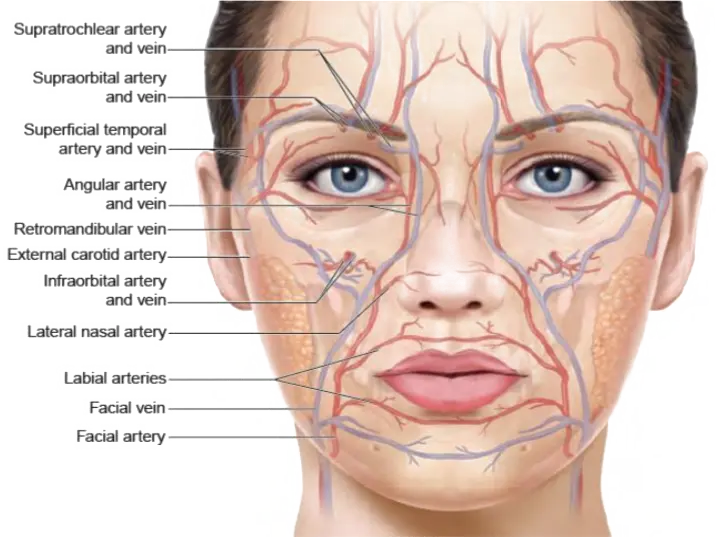
Facial blood vessel structure
The vascular structure of the face consists of a complex system of arteries and veins. Facial arteries run in a tortuous fashion from the neck, through the lower jaw, and up to supply the areas around the corners of the mouth, cheeks, nose, and eyes. Veins run parallel to the arteries to drain blood, and there are small capillaries (telangiectasia) distributed near the skin, particularly in the cheekbones and around the nose.
The structure of blood vessels in the face is as follows:
- Facial artery It branches off from the external carotid artery in the neck, winds through the lower jaw, ascends the cheek, and terminates as the angular artery in the inner corner of the eye.
- Facial veins The jugular vein is a blood vessel that runs parallel to the artery, but is straighter and located behind it. Its function is to drain blood from the midline of the face into the internal jugular vein.
- Facial capillaries (Telangiectasia) The blood vessels are small but dilate, becoming visible as red or purple lines resembling spiderwebs. This often appears on the cheekbones, forehead, and nose, due to thin skin that is affected by external factors such as sunlight.
- Anatomically, facial blood vessels are embedded deep within the lower part of the cheek fat flap, separated by a tortuous membrane covering the jawbone to accommodate facial movements such as chewing or speaking.
Where can I get filler injections?

| Injection site | Purpose of injection |
| The forehead | Fillers focus on filling in areas that have sunken or flattened. After injection, the face will look softer, more defined, and can enhance facial features according to traditional beliefs. |
| Temple | Fillers focus on filling in sunken areas or hollow temples. After injection, they help to reshape the face and reduce the prominence of the cheekbones. |
| Under the eyes | Fillers focus on filling in deep wrinkles and reducing the appearance of fatigue under the eyes. After injection, the face will look brighter and dark circles under the eyes will be reduced. |
| Upper eyelid | Fillers are primarily used to correct sunken or hollow eyes. After injection, the eyes appear fuller, the face looks younger, and less tired. |
| nose | Fillers focus on reshaping the bridge and tip of the nose. After injection, the nose will appear more prominent and defined. |
| Orange cheeks | Fillers focus on lifting the mid-face, giving the face more dimension and helping to lift sagging cheeks for a firmer appearance. |
| Nasolabial folds or marionette lines | Fillers focus on filling in deep wrinkles around the nose and mouth, resulting in a more youthful appearance after injection. |
| mouth | Fillers focus on reshaping the lips and adding volume, making them look fuller and more moisturized. |
| chin | Fillers focus on reshaping the face to make it appear longer, resulting in a slimmer face and helping to correct short or square chins. |
| Face shape | Fillers are used to enhance facial contours, resulting in a sharper, more defined, and more sophisticated look after injection. |
| hand | Fillers focus on plumping up sunken or prominent hand veins, restoring a fuller, smoother, and more youthful appearance, preventing dryness and aging. |
| Dinghu | Earlobe fillerThis treatment focuses on filling in sagging, thin, or flattened earlobes caused by aging. It helps the earlobes appear fuller, more shapely, and is ideal for those whose earlobes have become stretched or less attractive after wearing earrings. |
Which areas require extra caution when injecting filler?
Filler injections involve injecting a filler substance into the skin layers. Some injection sites may have numerous blood vessels, and an incorrect injection can lead to serious side effects such as tissue necrosis or blindness.
Here are 5 dangerous locations that require special attention to blood vessels:
Forehead and between the eyebrows This is a high-risk area because it has many blood vessels that connect directly to the blood vessels in the eye. If the injection is incorrect, it can cause a blockage in the blood vessels supplying the retina, resulting in immediate blindness. In addition, the skin in this area is delicate and has little subcutaneous tissue, making it susceptible to tissue necrosis.
nose The nose is a high-risk area because it has a large number of capillaries connected to the blood vessels of the eyes. Therefore, nasal injections create high pressure within the tissue. If the injection is in the wrong layer or too much filler is used, it can lead to necrosis of the nasal tip or blindness.
Nasolabial folds This is a moderate to high-risk area because a major blood vessel called the facial artery runs along the side of the nose. If the injection is too deep or in the wrong location, it can cause blood vessel blockage, leading to deprive blood supply to the skin around the nostrils and upper lip, potentially causing necrosis.
Temple This is a moderate-risk area because blood vessels run through both the superficial and deep layers of the temples. Doctors performing injections in this area must be highly skilled to inject the filler into the correct layer; otherwise, it can lead to blockages or severe bruising and swelling.
Under the eyes This is a moderate-risk area because the area under the eye has important blood vessels that emerge from the pores. If injected into this area, it can cause significant swelling and bruising. In severe cases, the filler may block blood vessels supplying the eye.
How to choose a clinic and doctor before getting filler injections.
Filler injections are a procedure that helps to reshape the face, add volume, and lift and tighten. Therefore, the doctor must be skilled and precise to prevent serious side effects such as tissue necrosis, blockage, and blindness. You should choose a clinic and doctor with the following characteristics:
- Clinics or service establishments must have a medical facility license and a clear, verifiable 11-digit license number.
- The medical team must have a medical license or medical license and must be skilled in filler injections.
- The medical team should have knowledge of the structure of the face and be able to analyze problems and select the right products for each individual.
- The clinic must choose standard equipment that is clean, sterile, and uses genuine drugs, such as using genuine fillers, to reduce the risk of allergic reactions.
- The clinic should have a variety of products to suit the problems and needs of those who come to use the service.
- The clinic must provide consultation services and be able to answer patients' questions correctly.
- There must be reviews from those who have actually used the service, especially cases related to filler injections.
- Clinics or service locations must meet standards and have sufficient equipment for safety.
- The clinic or service provider must provide detailed explanations before the procedure and how to take care of yourself after the procedure. The medical team must also follow up on the results after the procedure.
- The clinic or service location should be located in a location that is convenient for travel.